The Challenge
Healthy soils are fundamental for food security, climate resilience and ecosystem services in the Mediterranean.
Yet, large areas of the Mediterranean region face severe:

Soil degradation

Water scarcity

Erosion and salinization

Risk of desertification

Declining productivity
affecting smallholders
25% of global greenhouse gas emissions from land
clearing, crop production and
fertilization
1M species threatened with extinction
25% farmland at risk
Soil erosion on arable or intensively grazed lands 100-1000x higher than natural rates
3.2B people affected by land degradation globally
$577B in annual global crops production at risk from pollinator loss
Up to 50% crop loss due to soil erosion
100M hectares of land lost yearly
33% Earth's soils already degraded worlwide
1.4B hectares of land affected by salinity

Sources
Living labs
OSTARA validates its framework through Demonstration Sites across Mediterranean agroecosystems under arid and semi-arid conditions.
See all Living LabsFrance
This site applies a Digital Twin model integrating real-time soil moisture data, weather forecasts and crop-specific needs to simulate field conditions.
The system provides optimal irrigation timing and has demonstrated water savings of up to 25% without yield loss.
View moreSpain
This Living Lab evaluates an automated feeding system designed to minimise resource waste, reduce environmental impact and improve animal welfare and meat quality.
The system analyses relationships between operational inputs and outputs to optimise efficience in extensive cattle farming.
View moreItaly
This Living Lab revitalises semi-abandoned land through agroecological practices supported by digital tools.
It enables precise irrigation planning, early detection of water stress and informed decisions on crop diversification and companion planting under water-scarce conditions.
View moreMorocco
This Living Lab integrates Digital Twins with Trustworthy and Explainable AI to generate adaptive recommendations for crop rotation, intercropping and organic input timing.
The approach improves biodiversity and reduces dependency on synthetic inputs while strengthening farmer trust in digital tools.
View moreCyprus
This site focuses on improving sustainable nutrient management and emission mitigation in cereal-legume rotations and vegetable production.
Agroecological practices such as organic amendments, cover cropping and crop diversification are adapted to local constraints and monitored through adcanced diagnostics.
View moreSelect a point on the map
France
Digital twin-driven irrigation
Spain
AI and IoT systems for the improvement
of extensive livestock farming
Italy
AI and IoT to reduce
water consumption
Cyprus
Smart biosensing for sustainable
nutrient management
Morocco
Digital twins and explainable AI
for ecological decision-making

How Ostara works
Monitor
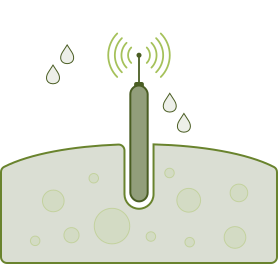
Low-cost IoT and biosensors
Low-cost Edge-IoT and biosensors developed to collect real-time physical, chemical and biological soil data directly in the field.
Harmonize
Shared soil data framework
A common agroecology ontology designed to integrate heterogeneous soil data from sensors and existing repositories across Mediterranean regions.
Predict
Explainable Federated AI
Trustworthy and explainable federated AI models developed to analyze distributed data to predict soil health, crop yields and carbon sequestration.

Transform
Agroecological decision-making
Integrated monitoring and AI insights will support informed farm-level decisions for sustainable soil management and climate resilience.

News and events


Funding

The content of this website represents the view of the OSTARA project only and is its sole responsibility. It does not necessarily reflect the opinion of the European Union or the PRIMA programme.