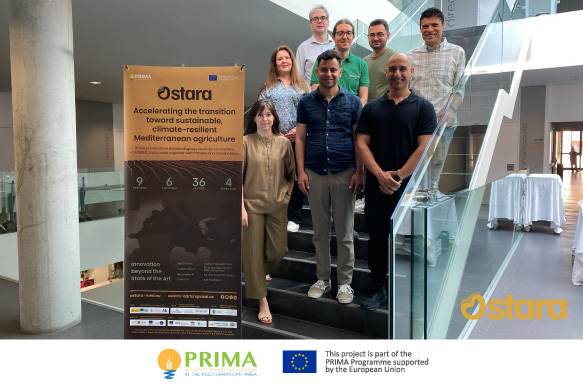
With its kick-off meeting held in Salamanca on 6–7 July 2026 (first day to be confirmed), OSTARA (Operationalizing Agroecology for Resilient Mediterranean Agriculture) has officially begun. The project is funded by PRIMA and coordinated by the University of Salamanca (USAL). It will run for 36 months and brings together nine organisations from six countries: Spain, Greece, Cyprus, Morocco, Egypt and France.
A Mediterranean Consortium, Meeting in Two Formats
The meeting took place in hybrid format. Some partners sat around the same table in Salamanca, while others joined the sessions online. In the room were the University of Salamanca (USAL), AIR Institute, the University of Reims Champagne-Ardenne (URCA), SK Embio Diagnostics (EMB) and Ibn Zohr University (UIZ). Joining remotely were Aethon Engineering, Heliopolis University, the Arab Academy for Science, Technology and Maritime Transport (AASTMT), and SQLI/JASSP.
Day one opened with a welcome session, an overview of the project, and a round of introductions in which each partner presented their role. This was followed by a presentation from PRIMA's Project Officer. The afternoon covered project management and coordination, and the communication and dissemination strategy.
From the Field to the Data: A Tour of the Project
The second day walked through the project work package by work package:
- Roadmap, diagnosis and mapping of Mediterranean agroecological practices — the project's starting point.
- Digital twin, green digitisation and traceability for organic agriculture.
- Trustworthy AI applied to agroecological management.
- Design and validation of low-cost monitoring systems, so the technology reaches those farming with fewer resources too.
- Validation on demonstration farms and agroecological Living Labs, where everything developed will be put to the test.
- Knowledge exploitation and extension to the certified Living Labs network.
Four Use Cases Bringing Technology to the Land
The meeting also introduced the four use cases that will give the project its practical edge:
- Real-time soil and microclimate monitoring for climate-resilient organic vegetable systems in semi-arid conditions.
- IoT and AI to improve livestock farming.
- Digital twin-driven irrigation, reducing the water footprint of Mediterranean organic farms.
- Digital twins and explainable AI for ecological decision-making.
The day closed with meetings of the Steering Committee and the Data Management, Innovation and Scientific Publishing Boards.
More Than a Work Meeting
Between sessions there was time to connect. Day one ended with a guided tour of Salamanca's historic city centre and a dinner at Martinica restaurant. In a project bringing together people from six countries and several languages, moments like these help build the trust and shared working style the next three years will run on.
What Comes Next
With teams now aligned, the real work begins. Over the coming months, OSTARA will be sharing its progress, its Living Labs and its results. Follow us on LinkedIn and at ostara-med.eu to stay updated.
OSTARA is funded by the PRIMA programme, supported by the European Union.